You have a large metal part to make. A structural bracket, a pressure housing, a forging die, a meter-scale impeller. The design is locked. Now comes the decision that sets your cost, your lead time, and sometimes whether the part is even practical to build: cut it from solid stock, grow it layer by layer, or do both.
With large parts, that call carries real money. Choose wrong and you can burn weeks of spindle time, turn a pallet of titanium into chips, or miss a program milestone waiting on raw material that takes months to source.
This is a process comparison, not a competitor comparison. What follows is a straight look at subtractive machining, large-format metal additive manufacturing, and hybrid workflows, plus a framework for picking between them. Baker Industries runs all three under one roof, so this reflects what happens on the floor, not a case for one method over the others.
The short answer: match the process to the part
Should you machine or 3D print a large metal part? Start with four variables: geometry, material, production volume, and the tolerance, lead time, and cost you can accept.
- Machining wins when the part is mostly prismatic, tolerances are tight across the whole surface, and the material is affordable to cut away.
- Metal additive manufacturing wins when the part is large, the alloy is expensive, and machining from a solid billet would waste most of the metal.
- Hybrid wins when you need the material efficiency of additive and the precision of machining on the same part, which describes most large aerospace and energy hardware.
None of these is universally cheaper or faster. The right answer depends on the part in front of you. Here is how each process actually behaves.
3D printing vs CNC machining: a quick primer on each process
CNC machining (subtractive)
CNC machining starts with a solid block, bar, or forging and cuts material away until the finished shape remains. It is the reference standard for precision. Multi-axis mills and lathes hold tight tolerances and produce excellent surface finish directly off the machine.
The tradeoffs show up at size:
- Material cost and availability. Large billets of titanium or nickel alloy are expensive and can carry long procurement lead times.
- Waste. Every kilogram you cut away is paid for, then discarded as chips.
- Machine time and reach. Roughing a large pocket consumes spindle hours, and some internal features are impossible to reach with a tool.
Large-scale metal 3D printing and WAAM
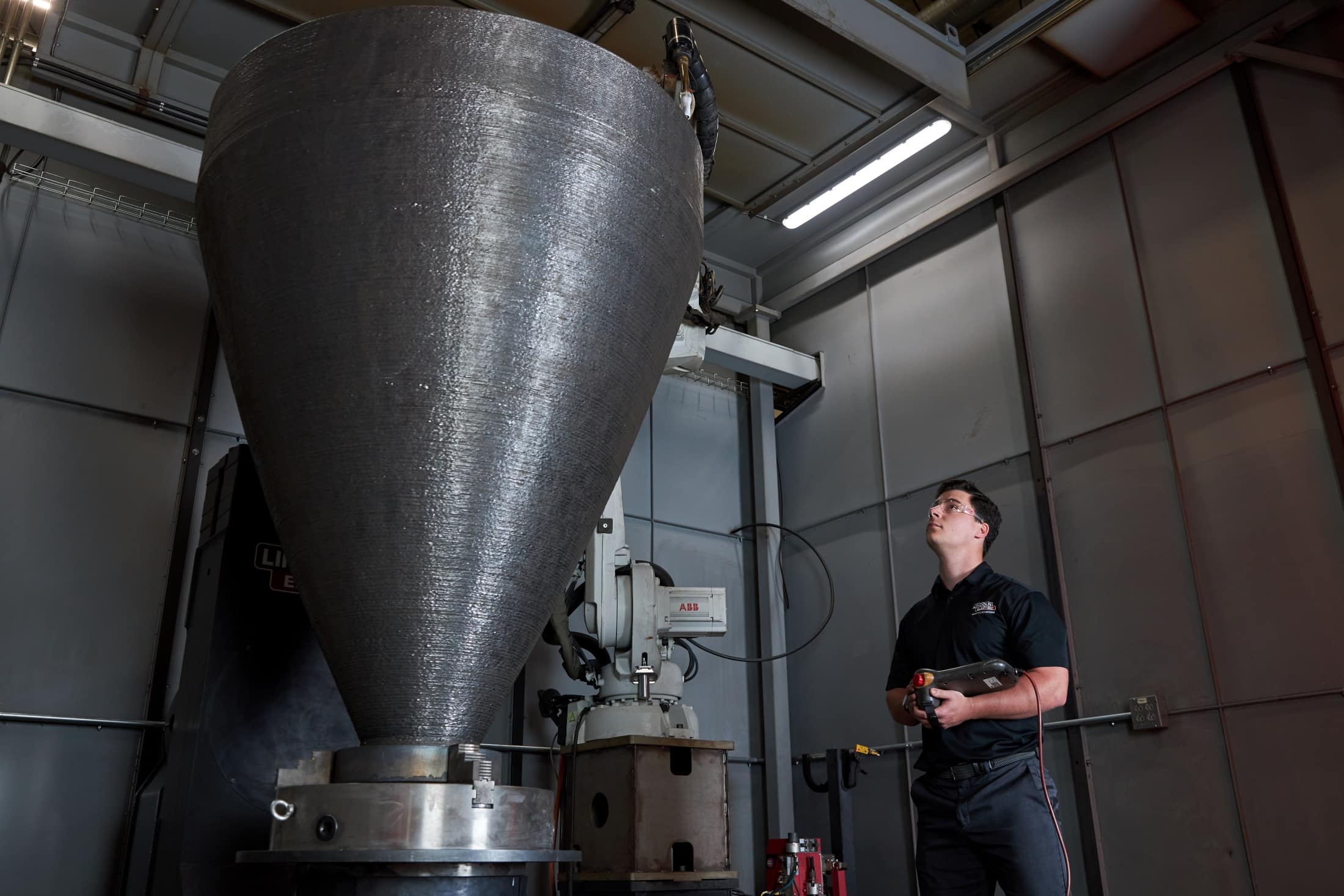
Metal additive manufacturing builds a part up rather than cutting it down. For large parts, the most relevant process is wire arc additive manufacturing, or WAAM.
WAAM uses an electric arc to melt a metal wire feedstock and deposits it as weld beads, layer by layer, along a programmed path. It is a form of directed energy deposition.
Because it lays down metal fast, with deposition rates that can reach around 10 pounds per hour, it builds large near-net-shape structures measured in feet rather than inches. That speed and scale are why WAAM leads the conversation on large scale metal 3D printing.
The tradeoff is finish and tolerance. A WAAM part comes off the cell as a rough near-net shape with a wavy surface and internal stress. It is not a finished part. It is a smart starting blank that uses a fraction of the material a billet would have.
Hybrid manufacturing
Hybrid manufacturing combines the two. You print a near-net shape with additive, then machine the critical features to final tolerance. Some systems do both in one machine; more often the part moves from an additive cell to a CNC machine in a controlled sequence.
This is the practical answer to additive versus subtractive manufacturing for most large, high-value parts. You do not have to choose one. You use additive where it saves material and subtractive where it delivers precision.
Buy-to-fly ratio: where metal additive manufacturing changes the material math
The buy-to-fly ratio is the weight of raw material you buy divided by the weight of the finished part. It is one of the clearest reasons additive earns its place in large parts.
Large machined parts in aerospace and energy routinely run a buy-to-fly ratio of 10 to 1 or worse. A 10 kilogram finished part can start as a 100 kilogram billet, with up to 90 percent of that expensive metal removed as chips.
WAAM changes the math. Deposited near-net shapes can bring the ratio under 2 to 1, cutting material use by more than 80 percent against conventional machining.
The savings scale with the part and the alloy. On stainless steel structural components, material savings can exceed 95 percent compared with machining from solid. One energy-sector example replaced a 2.3 ton machined block with a 700 kilogram WAAM blank, saving more than 1.6 tons of metal on a single part.
|
Metric |
Subtractive machining |
WAAM additive |
|---|---|---|
|
Typical buy-to-fly ratio (large parts) |
10 to 1 or worse |
Under 2 to 1 |
|
Material removed as waste |
Up to 90 percent |
Minimal (near-net shape) |
|
Material savings vs machining |
Baseline |
Up to 80 percent or more |
|
Deposition / build rate |
N/A (removal) |
Up to ~10 lbs per hour |
|
Not sure where your part lands on that curve? |
When hybrid manufacturing is the smart move
Hybrid earns its keep when a part is both large and precise, which describes most flight and energy hardware. The logic is simple. Additive gets you close to the final shape with minimal waste. Machining then finishes only the surfaces that need tight tolerance: bearing bores, sealing faces, mounting interfaces.
Consider hybrid when any of these are true:
- The alloy is expensive and the machined buy-to-fly ratio would be high.
- The part is large enough that billet or forging lead time threatens your schedule.
- Only a portion of the part needs tight tolerance.
- You need a large, mostly simple form with a few precise features.
In those cases, printing near-net and machining to tolerance beats machining alone on cost and material, and often on lead time.
Cost and lead time at large sizes
For small, simple parts, machining from stock is usually cheapest and quickest. The picture changes as parts get large and alloys get expensive.
What drives cost: additive vs subtractive manufacturing
Machining cost is driven by material bought, spindle hours, and tool wear. On a large nickel-alloy part, all three climb together. Additive cost is driven by deposited weight and machine time, and it is far less sensitive to how much of a bounding box you remove.
Where lead time actually breaks
Lead time is where additive often surprises people. A large forging or billet can take months to procure, while wire feedstock is comparatively easy to keep on hand, so a printed near-net blank can start sooner.
The honest tradeoff
Additive adds post-processing steps such as stress relief, heat treatment, and finish machining. On a small or moderately priced part, those steps can erase the savings. On a large, expensive, low-to-mid volume part, they rarely do.
|
Factor |
Machining alone |
Additive (WAAM) |
Hybrid |
|---|---|---|---|
|
Material efficiency |
Low on large parts |
High |
High |
|
Tolerance and finish |
Excellent |
Rough / near-net |
Excellent on machined features |
|
Best part size |
Small to large |
Large |
Large |
|
Lead time on costly alloys |
Longer (material procurement) |
Shorter (wire feedstock) |
Shorter than machining alone |
|
Best fit volume |
Any |
One-off to low |
One-off to mid |
Material considerations: Inconel, and steel
Material choice often decides the process on its own.
- Nickel superalloys (Inconel). Alloys such as Inconel 625 and 718 are costly and hard on tooling. Reducing how much you machine cuts both material spend and tool wear. Additive and hybrid workflows are a strong fit for large nickel-alloy parts in energy and propulsion.
- Steel. Steels, including stainless and tool steels, are more affordable and machine well, so the material-savings argument is weaker. Additive still helps on very large steel forms, long lead-time forgings, or geometries that are hard to reach with a tool. For many steel parts, machining from stock remains the practical choice.
How to choose: a process selection framework
A good process decision happens before the first chip or the first bead, with design-for-manufacturing input. Baker’s team looks at the part through a few questions:
- Geometry. Is the part prismatic and tool-accessible, or large and organic? Accessible and prismatic favors machining. Large, complex forms favor additive.
- Material and cost. How expensive is the alloy, and what would the machined buy-to-fly ratio be? Costly alloys with high ratios favor additive or hybrid.
- Tolerance. Which surfaces actually need tight tolerances? If only a few, hybrid lets you print the bulk and machine the rest.
- Lead time. Can you get the billet or forging in time? If procurement threatens the schedule, a printed near-net blank can start sooner.
- Volume. One-off and low-volume parts favor additive and hybrid. Higher volumes may justify machining or tooling-based methods.
The value is in the advice, not just the machines. Because Baker machines, prints, and finishes in one place, the recommendation is not anchored to a single method. Design choices can be adjusted early to suit whichever process wins, so you are not paying to force a part through the wrong one.
Frequently asked questions
Should I machine or 3D print a large metal part?
Machine it when the part is prismatic, tolerances are tight across most surfaces, and the material is affordable to cut. Print it when the part is large, the alloy is expensive, and machining from a billet would waste most of the metal. For large parts that are both expensive and precise, a hybrid approach, printing near-net then machining to tolerance, is usually best.
What is large-format or large-scale metal 3D printing (WAAM)?
WAAM stands for wire arc additive manufacturing. It uses an electric arc to melt metal wire and deposit it in layers, building large near-net-shape parts at deposition rates up to about 10 pounds per hour. It is the metal additive manufacturing process most often used for large scale metal 3D printing because it builds structures measured in feet with far less material waste than machining.
When is hybrid manufacturing better than machining alone?
Hybrid is better when a part is large and expensive but only needs tight tolerances on some surfaces. Printing the near-net shape cuts material and lead time; machining the critical features delivers precision. On a small or simple part, machining alone is usually simpler and cheaper.
Which is cheaper for big parts: additive or machining?
It depends on size, alloy, and volume. On large parts in expensive alloys like Invar® or Inconel®, additive and hybrid are often cheaper because they cut material waste from a 10-to-1 buy-to-fly ratio to under 2-to-1. On small or simple parts in affordable metals, machining from stock is usually cheaper.
What materials can be used for large metal 3D printing?
Common WAAM materials include nickel superalloys such as Inconel 625 and 718, stainless and carbon steels, and other weldable alloys. Expensive, hard-to-machine alloys like Invar and Inconel show the biggest cost and material benefit from additive.
|
Get the process decision right before you cut metal. |