Industrial scale demands more than a big build box. Here’s how wire-arc additive manufacturing (WAAM) plus CNC machining deliver meter-class metal parts faster and why the economics make sense.
What ‘Large-Scale’ Really Means in Industrial 3D Printing
There’s a bait-and-switch happening in additive manufacturing marketing. Someone says “large-scale 3D printing service” and shows you a powder bed system with a 600- to 800-millimeter build chamber. That’s fine for certain applications. But it’s not if you need a 6-foot turbine housing or a 2,000-pound structural component for a defense platform.
When we talk about large-scale metal 3D printing, we mean large-format metal parts measured in feet and meters. These components are for aerospace, energy, and heavy industry, where traditional casting lead times stretch past a year and machining from billet wastes 80–90% of raw material. At that scale, powder bed fusion struggles. It hits a hard ceiling on physics, cost, and time.
This point is where wire-arc additive manufacturing steps in, not as a novelty, but as a production-viable path for truly massive metal parts.
Why Wire-Arc Additive Manufacturing Outperforms Powder Bed at Scale
Powder bed systems like selective laser sintering (SLS) and direct metal laser sintering (DMLS) deposit material at rates measured in grams per hour. They require enclosed, inert-atmosphere chambers that limit build volume. And as you scale up, the costs compound. More powder, longer build times, higher failure risk.
For structural metal parts in the meter-class range, you’re stacking the deck against yourself.
How WAAM Changes the Equation
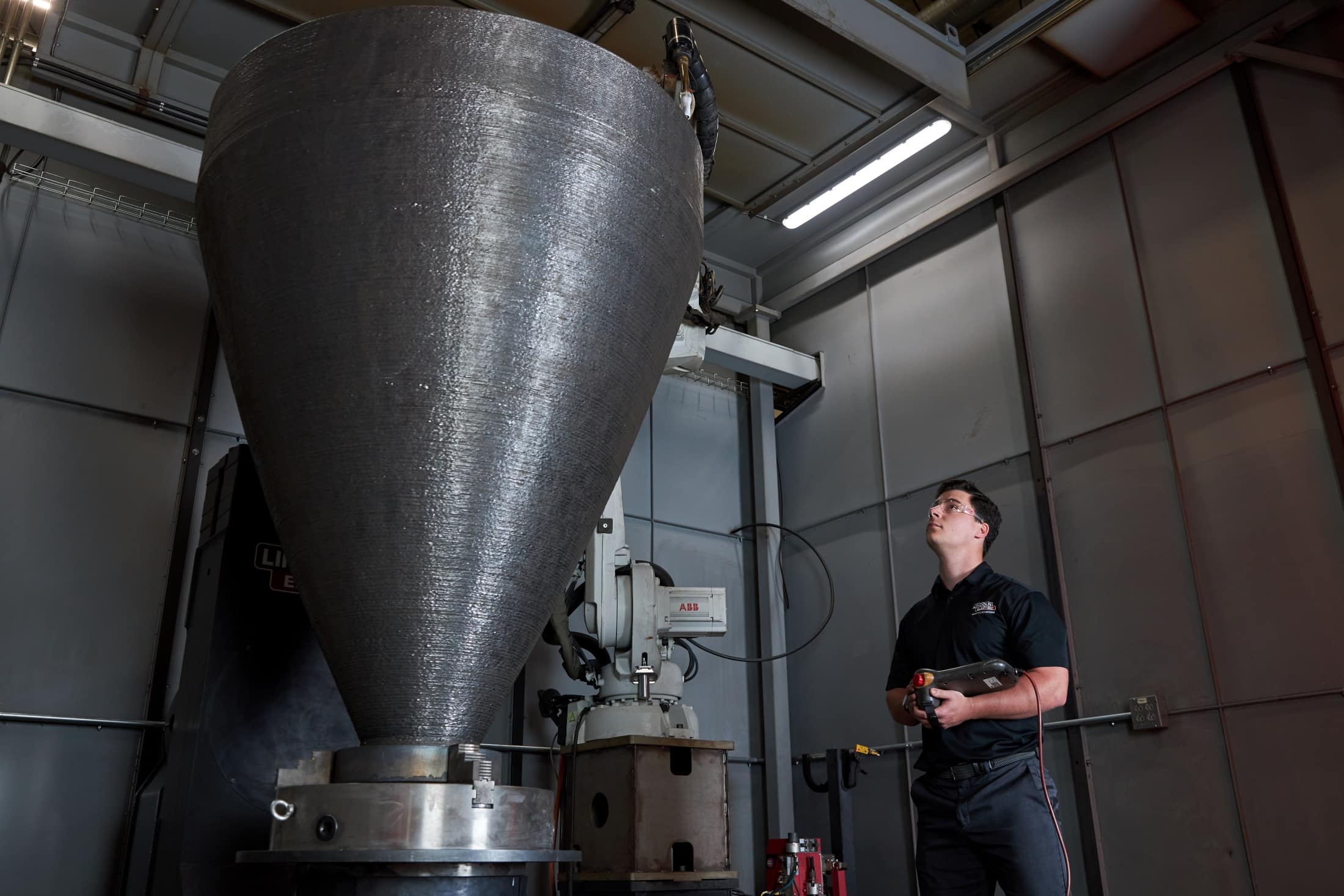
Wire-arc additive manufacturing uses an electric arc to melt metal wire feedstock, deposited layer by layer via robotic motion. No chamber required. Deposition rates typically run 5–10 pounds per hour, with advanced systems pushing well beyond that.
The feedstock matters, too. Wire costs roughly a tenth as much as equivalent metal powder, and the material selection is broad: stainless steel, nickel alloys like Inconel®, titanium alloys, aluminum-nickel-bronze, Invar®, and more.
When a Large-Scale 3D Printing Service Makes Sense
Not every part is a WAAM candidate, and honesty about that realization matters more than a sales pitch. Here’s how to think about it.
WAAM is the right call when:
- Your part exceeds roughly one meter in any dimension or weighs several hundred pounds.
- You’re working with expensive alloys, where machining buy-to-fly ratios are brutal.
- You’re staring down 40–52-week casting lead times and need delivery in weeks, not quarters.
- You need complex geometries that require multiple castings, forgings, or weldments consolidated into a single near-net-shape component.
You might want another process when:
- The part requires extremely fine internal features, such as micro-cooling channels.
- You’re running high-volume commodity production where casting tooling amortizes well.
- The application demands thin cosmetic surfaces over large spans, where the layered deposition profile of additive manufacturing technologies would require excessive post-processing.
The Hybrid Workflow: From Near-Net Print to Precision Part
Printing a massive near-net-shape component is only half the job. What separates an industrial 3D printing service from a science project is the ability to deliver a finished, inspected, ready-to-install part.
That goal means integrating WAAM with CNC machining using 5-axis machining centers to bring critical interfaces, bores, and mating surfaces into tight tolerances. It means applying stress relief and heat-treatment protocols appropriate for the alloy and application. And it means verifying integrity through CMM inspection, 3D scanning, and quality systems aligned with standards such as AS9100.
This hybrid manufacturing approach (additive deposition followed by subtractive finishing) is where the real value lives. You get the speed and material efficiency of additive manufacturing with the dimensional precision of CNC machining, managed under one roof with a complete chain of custody.
The Business Case: Service Bureau vs. Machine Ownership
Buying a robotic WAAM cell, retrofitting your facility for ventilation, power, and safety shielding, hiring specialized welding engineers, developing path-planning software, and investing in post-processing equipment is a multimillion-dollar commitment before you print a single part. And if your utilization rate doesn’t justify the capital, every part carries the weight of an underused asset.
Converting Risk to Results with an Industrial 3D Printing Service
Partnering with a large-scale 3D printing service provider converts that CapEx risk into OpEx flexibility. You pay for parts, not infrastructure. You scale up and down without carrying fixed overhead. And you tap into process expertise that took years and thousands of builds to develop, without the learning curve.
For many manufacturers, especially those exploring additive manufacturing technologies for the first time, that trade-off isn’t even close.
Working with Baker Industries on Large-Scale Additive
We bring the full hybrid manufacturing workflow under one roof, from design consultation and WAAM printing through precision CNC machining and final inspection. That single-source contract manufacturing approach means fewer vendor hand-offs, tighter quality control, and a faster path from concept to delivered part.
Whether you’re evaluating WAAM for the first time or looking to move an existing casting or forging program to additive manufacturing, our engineering team can help you assess fit, talk through materials and tight tolerances, and figure out the smartest way to get your 3D-printed parts made.
To get started, request a quote today.
Frequently Asked Questions
What is wire-arc additive manufacturing (WAAM)?
WAAM is a directed energy deposition (DED) process that uses an electric arc to melt metal wire feedstock, building parts layer by layer via robotic motion. It produces large-format, near-net-shape components at deposition rates of several pounds per hour, making it one of the most capable industrial 3D printing processes available for massive metal parts.
What materials can be used with a large-scale 3D printing service?
Baker Industries prints in a wide range of industrial metals, including various stainless steels, nickel alloys (such as Inconel), titanium alloys, aluminum-nickel-bronze, Invar 36, and more. Material selection depends on your application requirements, mechanical loads, and operating environment.
How large can WAAM parts be?
Parts produced using our large-scale 3D printing service are measured in feet or meters. Unlike powder bed systems constrained by enclosed chambers, WAAM uses open-architecture robotic systems, where part size is primarily limited by robot reach and positioner setup. Baker Industries can print up to 10 feet by 10 feet by 7 feet in a single build, with larger assemblies achievable through post-print joining strategies.
How does WAAM compare to casting for large metal parts?
Casting typically requires 40–52-plus weeks of lead time due to tooling and pattern development. WAAM can deliver near-net-shape parts in a fraction of that time. For low- to medium-volume 3D printing services or complex parts with demanding geometries, additive manufacturing often offers significant cost reduction and schedule advantages over traditional casting.
Do WAAM parts require post-processing?
Yes. Near-net-shape manufacturing means the printed part is close to final dimensions but requires CNC machining on critical surfaces, stress relief or heat treatment, and inspection. Baker Industries manages this hybrid manufacturing workflow—print, heat treat, machine, and inspect—from a single source.
What information do I need to request a quote?
Send your 3D CAD files (STEP or IGES preferred), 2D drawings with GD&T callouts, material specifications, and any relevant quality or certification requirements. Our engineering team will assess manufacturability and provide lead time and cost estimates.